Bodyconscious Digital Rave: Difference between revisions
Created page with "thumb|right| = Overview = *'''Full Name:''' Bodyconscious Digital Rave! Part 1: Shinjuku & Takashi *'''Code:''' TPS-18011 *'''Type:''' No..." |
No edit summary |
||
| (One intermediate revision by the same user not shown) | |||
| Line 1: | Line 1: | ||
[[Image: | [[Image:Bodyconscious_Front.jpg|thumb|right|]] | ||
= Overview = | = Overview = | ||
| Line 19: | Line 19: | ||
Another one of those Japanese-only 'games' that truly defined the 3DO as the ultimate multimedia masterpiece of the early 90s. (In other words, it's just a video formatted to only play on the 3DO system) A oddity, Body Conscious Part 1- Shinjuku & Takashi Digital Rave ! simulates the nightlife of Japan by taking you to the club scene where you can engage in simulated partying. | Another one of those Japanese-only 'games' that truly defined the 3DO as the ultimate multimedia masterpiece of the early 90s. (In other words, it's just a video formatted to only play on the 3DO system) A oddity, Body Conscious Part 1- Shinjuku & Takashi Digital Rave ! simulates the nightlife of Japan by taking you to the club scene where you can engage in simulated partying. | ||
== Disc Archaeology == | |||
''Findings from a byte-level analysis of the Japanese retail disc image (357,130,240 bytes / 174,080 blocks). At 155 filesystem entries, this is one of the structurally simplest discs in the 3DO library.'' | |||
=== The entire production is one file named "test" === | |||
88% of the disc is a single 315,359,232-byte video stream — and its shipped filename is <code>/BodyData/Stream/test.weaver</code>. The name is the tell-tale default output of the 3DO SDK's <code>weaver</code> stream-building tool: the production's one and only content file went to press still named "test", and the player executable hard-codes <code>$Stream/test.weaver</code> to play it. | |||
=== The player is 3DO's sample code === | |||
The 78,032-byte <code>launchme</code> is a lightly-dressed version of the 3DO SDK's example Cinepak stream player — the SDK sample source filenames survive in its assertion strings (<code>:PlayCPakStream.c</code>, <code>:PrepareStream.c</code>) alongside a single project-specific file, <code>:Body.c</code>. The interface is a set of VCR-style CELs (<code>Play</code>, <code>Pause</code>, <code>Step</code>, <code>Rew</code>, <code>Fwd</code>, <code>Help</code>, <code>Select</code>), including the romanization slip <code>Cursol.cel</code> ("cursor") and a load-error message that truncates the publisher's own name: ''"Cannot load in Transe"'' (for <code>TransPegasus.CEL</code>). | |||
=== The debugger is told about every retail boot === | |||
The startup script ends by running <code>$c/informdebugger</code> — the development-kit utility that announces the title to an attached debugging Mac — left in the boot sequence of the retail pressing. | |||
=== The only text on the disc is a 47-digit number === | |||
<code>/BodyData/Text/Chapter.txt</code>, the file the player loads as its "ChapterText", contains exactly this and nothing else: | |||
<code>13581123957155865618830190074111367200555248761</code> | |||
— a packed chapter-seek table for navigating the video stream, shipped as the disc's entire textual content. | |||
=== No credits text === | |||
A full-image search (including Shift-JIS sweeps for スタッフ, 制作, 出演, 監督 and similar headers) confirms no staff text exists anywhere on the disc — any credits are baked into the video stream itself. | |||
=== Filesystem notes === | |||
The redundant directory copies ("avatars") of <code>/System/Drivers</code>, <code>Folios</code>, <code>Programs</code> and <code>Scripts</code>, plus <code>rom_tags</code>, disagree between copies — stale older generations from multi-pass mastering. The root directory copies verify hash-identical, so this is a mastering artifact, not dump damage. | |||
=== Unallocated space === | |||
19,331 blocks (~38 MB, 11% of the disc) belong to no file, in a single run. Every byte was checked: 100% standard <code>iamaduck</code> mastering filler, nothing hidden inside. | |||
== Media == | == Media == | ||
Latest revision as of 06:32, 14 August 2026

Overview
- Full Name: Bodyconscious Digital Rave! Part 1: Shinjuku & Takashi
- Code: TPS-18011
- Type: Non-game, Adult, Interactive movie
- Developer: Trans-Pegasus Limited
- Publisher: Trans-Pegasus Limited
- Language: Japanese
- Release Date: December 23, 1994
- Region: JP
- Barcode:
- Local Title:
- Rarity: 1
- Notes: Title is a little misleading, as there was never a Part 2!
Overview
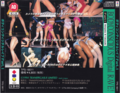
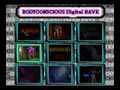
Another one of those Japanese-only 'games' that truly defined the 3DO as the ultimate multimedia masterpiece of the early 90s. (In other words, it's just a video formatted to only play on the 3DO system) A oddity, Body Conscious Part 1- Shinjuku & Takashi Digital Rave ! simulates the nightlife of Japan by taking you to the club scene where you can engage in simulated partying.
Disc Archaeology
Findings from a byte-level analysis of the Japanese retail disc image (357,130,240 bytes / 174,080 blocks). At 155 filesystem entries, this is one of the structurally simplest discs in the 3DO library.
The entire production is one file named "test"
88% of the disc is a single 315,359,232-byte video stream — and its shipped filename is /BodyData/Stream/test.weaver. The name is the tell-tale default output of the 3DO SDK's weaver stream-building tool: the production's one and only content file went to press still named "test", and the player executable hard-codes $Stream/test.weaver to play it.
The player is 3DO's sample code
The 78,032-byte launchme is a lightly-dressed version of the 3DO SDK's example Cinepak stream player — the SDK sample source filenames survive in its assertion strings (:PlayCPakStream.c, :PrepareStream.c) alongside a single project-specific file, :Body.c. The interface is a set of VCR-style CELs (Play, Pause, Step, Rew, Fwd, Help, Select), including the romanization slip Cursol.cel ("cursor") and a load-error message that truncates the publisher's own name: "Cannot load in Transe" (for TransPegasus.CEL).
The debugger is told about every retail boot
The startup script ends by running $c/informdebugger — the development-kit utility that announces the title to an attached debugging Mac — left in the boot sequence of the retail pressing.
The only text on the disc is a 47-digit number
/BodyData/Text/Chapter.txt, the file the player loads as its "ChapterText", contains exactly this and nothing else:
13581123957155865618830190074111367200555248761
— a packed chapter-seek table for navigating the video stream, shipped as the disc's entire textual content.
No credits text
A full-image search (including Shift-JIS sweeps for スタッフ, 制作, 出演, 監督 and similar headers) confirms no staff text exists anywhere on the disc — any credits are baked into the video stream itself.
Filesystem notes
The redundant directory copies ("avatars") of /System/Drivers, Folios, Programs and Scripts, plus rom_tags, disagree between copies — stale older generations from multi-pass mastering. The root directory copies verify hash-identical, so this is a mastering artifact, not dump damage.
Unallocated space
19,331 blocks (~38 MB, 11% of the disc) belong to no file, in a single run. Every byte was checked: 100% standard iamaduck mastering filler, nothing hidden inside.
Media
-
 Back
Back -
 Screenshot
 -
 Screenshot
 -
 Screenshot
 -
 Screenshot
 -
 Screenshot


